
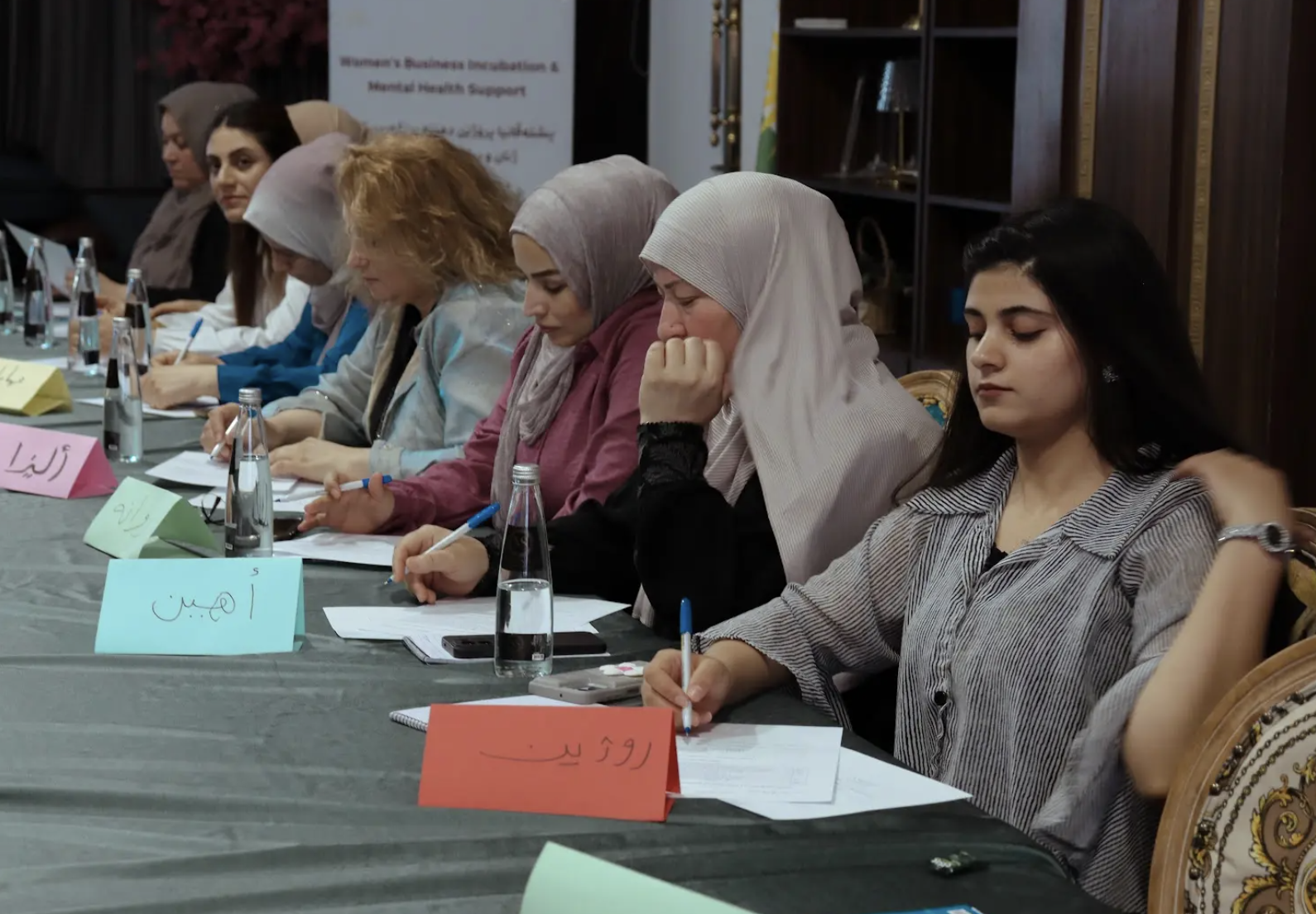
The Lotus Flower’s Women’s Business Incubator (WBI) is far more than a small-grants programme. Its women participants are supported through the entire process of starting and maintaining a business – from identifying a viable idea and learning the fundamentals of entrepreneurship, to receiving a grant to launch it and then mentoring to help sustain it. Community mental health support and awareness are also embedded into the programme.
Currently in the third year of a partnership with if! Foundation, the programme continues to deliver real, measurable impacts, as seen when our team recently surveyed 50 women supported over the past 18 months.
Here you can learn more about the process…
A Proven Model
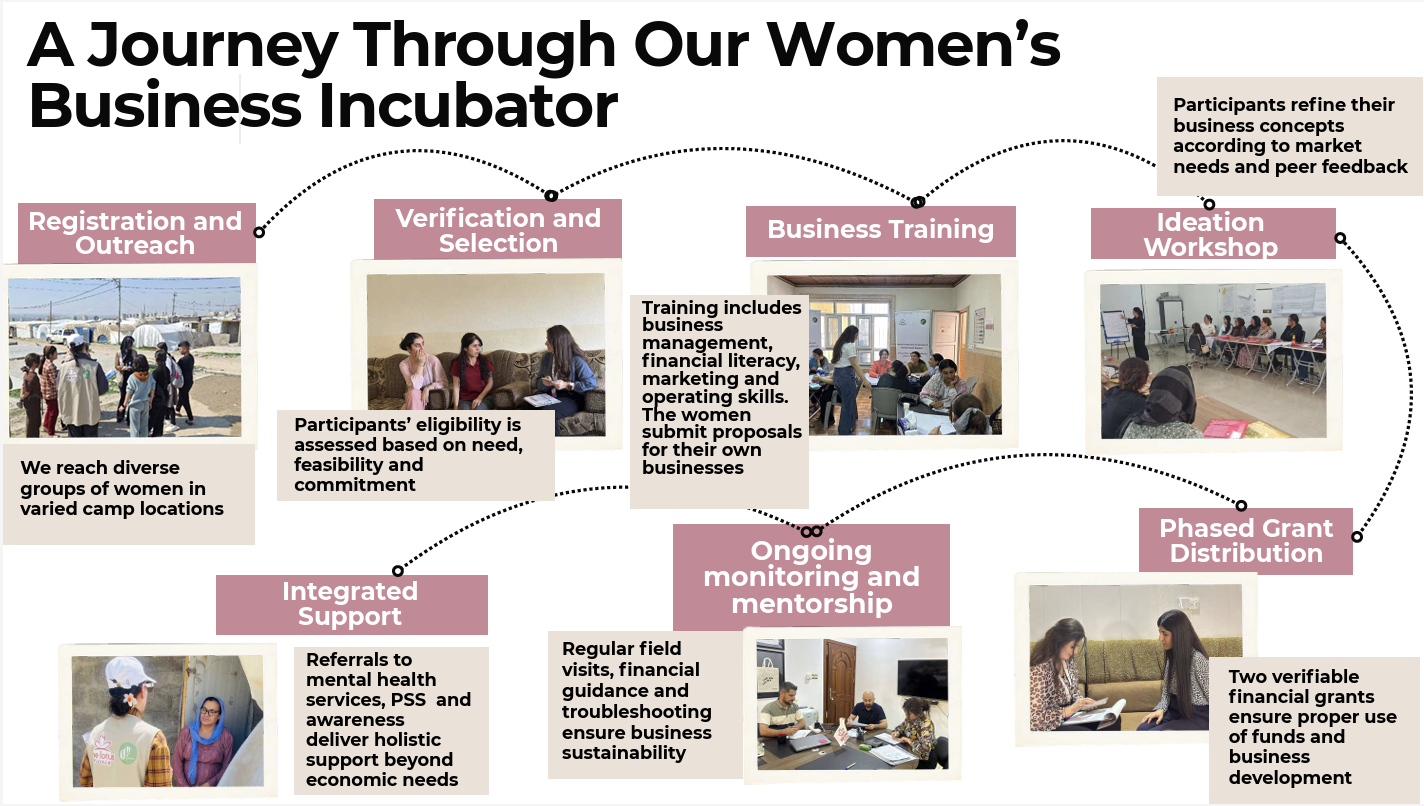
As a model that has previously won recognition with a UNHCR Award for Innovation, the WBI has been carefully structured to maximise impact and efficiency, as seen below:
The Selection Process
The WBI journey begins with outreach and applications from women both inside and outside of camps. This is overseen by our community mobilisers who have lived experience within these settings, and who have developed significant trust within them. Selection criteria is based around factors such as household circumstances, skills, commitment and whether their proposed business ideas could realistically work in the local market.
All of the women chosen are economically vulnerable, and of the 50 WBI participants recently surveyed, 82% had zero personal income before joining the programme.
Building Business Skills
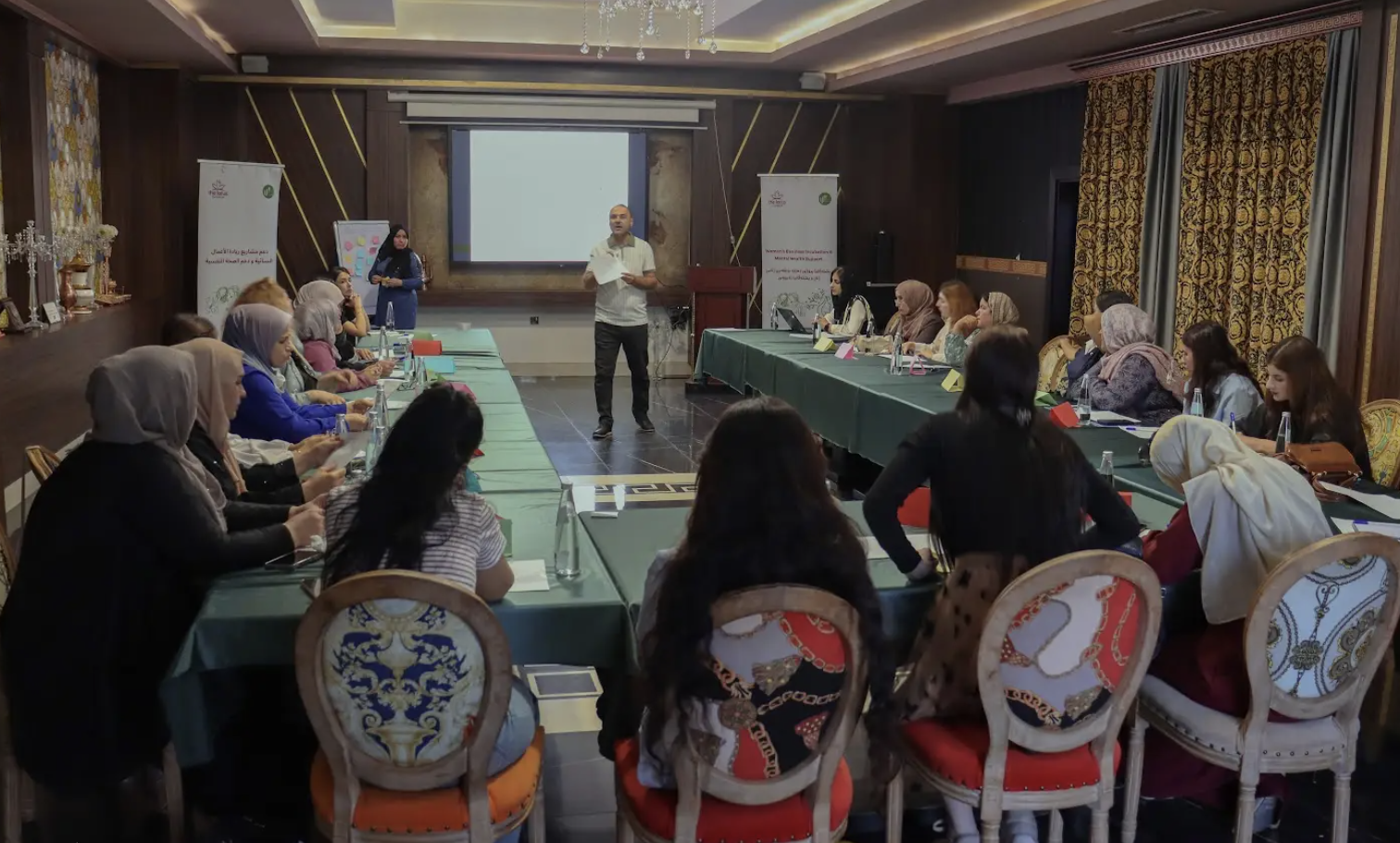
Once selected, the WBI sees the women take part in five days of business management training, covering business planning, marketing, costs, financial record-keeping, risk and sustainability. They also join ideation workshops, where they can test and refine their ideas with support from trainers and other participants. This helps determine whether their business is needed in the community, and if it is likely to be sustainable in the long-term.
A Flexible Approach
Although participants often have a specific idea for their business, it may not always be the right fit. One participant in Sharya who planned to start a handicraft business changed her plans completely when discussions about unmet needs in her community inspired another idea: a centre for autistic children.
Families currently have to travel to Duhok for such specialist support, and this is something she had experienced first-hand. “I have a child with autism but there are no centres in the area,” she said. “If I can open such a centre, it won’t only help parents with children who have autism, but also support others by providing them with a chance of working there.”
Her decision illustrated how women’s lived experience can bring solutions to challenges faced by many in their own communities.
Launching Their Businesses
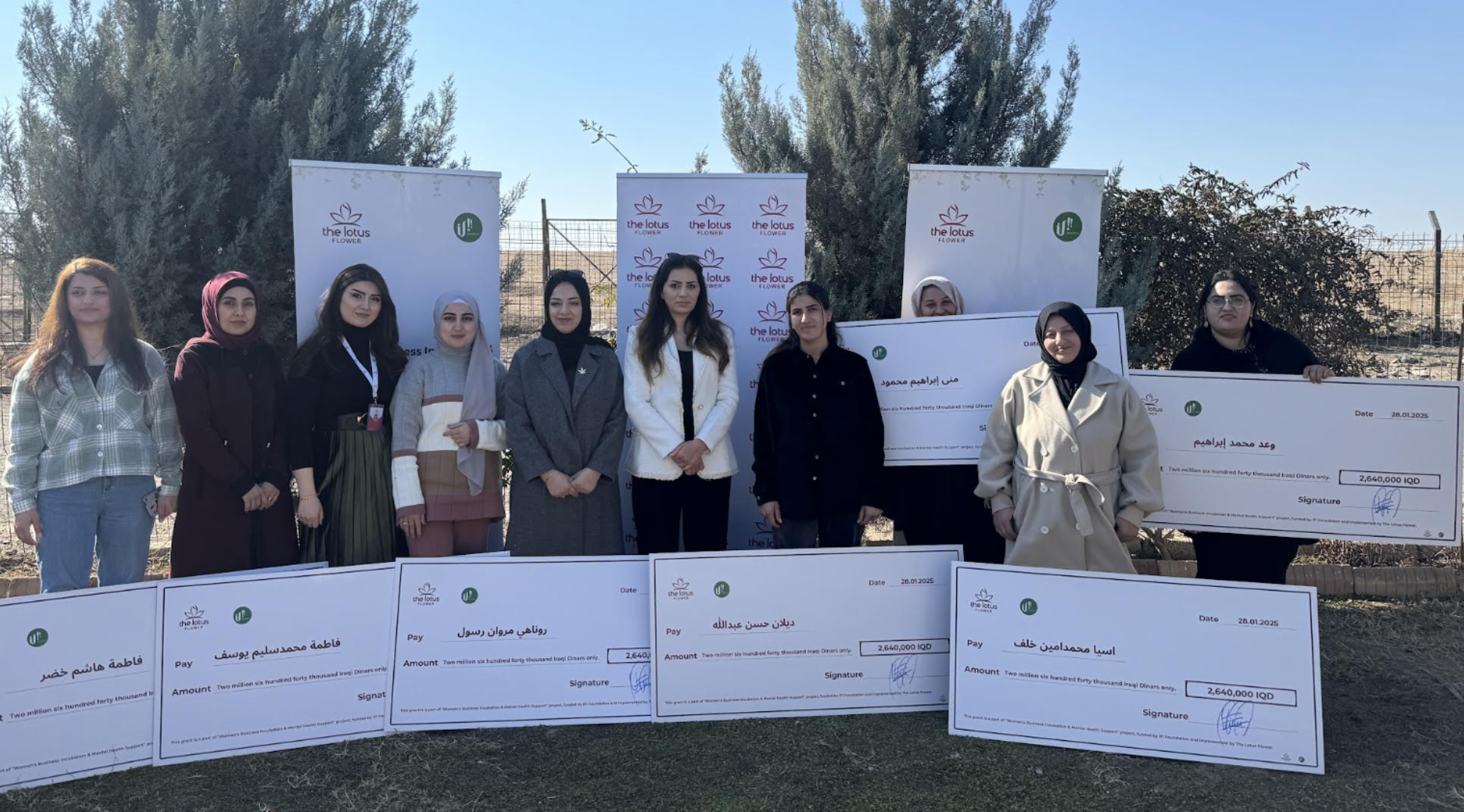
Once the participants’ business plans are finalised, the women each receive $2,000 grants to buy equipment, materials and the stock they need.
Businesses launched by the 50 women included in our recent survey included:
* Restaurants, cafés, bakeries and home cooking
* Textiles, jewellery, candles and oils
* Farming (sheep, mushrooms, poultry)
* Retail stores (cosmetics, electricals, groceries, clothing)
* Professional services (solar power, design, programming)
* Tailoring services
* Beauty and personal care (salons, nailcare)
After receiving their grant and establishing their businesses, the women continue to receive monitoring and mentorship, including field visits, financial guidance and practical help. If needed, they can also access mental health and psychosocial support.
Financial Impacts
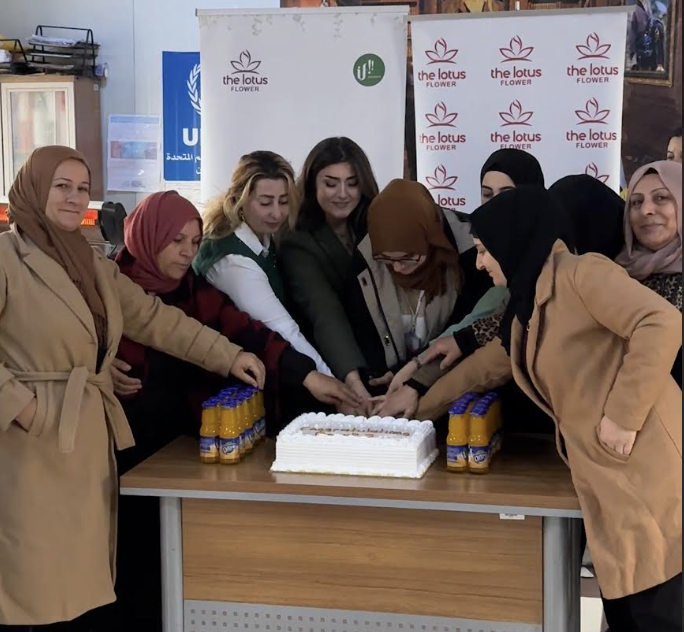
Our recent Post-Distribution Monitoring (PDM) report surveyed 50 of the women who started the WBI in two groups in January and November 2025. It brought an extremely encouraging set of results:
98% of the 50 women surveyed have registered businesses
41 of these are now fully operational
82% of these women said their monthly income has risen, exceeding the initial 70% target
Their average net monthly incomes have risen from 31,100 IQD (21 USD) per month to 384,500 IQD (256 USD)
96% of the women said they were “very satisfied” with the training they received
94% said they were confident their businesses would still be running in 12 months.
The individual responses we received from the participants were also highly positive, and comments included:
"I became an independent woman, and I feel happy."
"I feel better mentally, I have my own work and my own income, and even if I have to borrow, I know I can pay it back."
"It gave me hope and ambition."
Household Impacts
As well as the improved financial outcomes reported by the surveyed women, the PDM also showed favourable changes in household and family power dynamics. These mark a shift from economic dependence to decision-making authority, and highlight a fundamental change in household agency.
98% of the surveyed women said they independently decide how their business income is used
94% reported having more say in household financial decisions since starting their business
88% said family support is high (with 56% of these saying it is “very strong”)
74% said they manage the combined business-and-caregiving workload without difficulty.
Psychosocial Impacts
In addition to providing enhanced economic outcomes for groups of women, the WBI model provides mental health support and awareness activities across different communities.
This includes group and individual therapy sessions, focusing on evidence-based techniques such as deep breathing, relaxation, grounding and positive reframing.
One of the women who recently took part was a 32-year-old mother-of-four who had been suffering severe psychological distress, including depression, disrupted sleep and poor appetite. After receiving individual therapy, she learned to trust her psychologist and found relaxation techniques helped restore her sleep and eating routines. "Before I started this type of session, I thought I would only get better through medication and medical treatments,” she says. “I never expected that if I did such activities, I would see this great positive change in my life.”
Additionally, younger community participants take part in psychosocial support sessions, including art and music therapy. As part of our follow-up reporting, one 13-year-old girl said the art sessions helped her feel calmer, more cooperative, cheerful and engaged with her peers.
Finally, the programme also includes awareness sessions which are held in our centres and through outreach in schools and the wider community. These are also attended by males, and cover important topics including gender-based violence, climate change, education for girls, child marriage, suicide prevention, mental health, addiction, cyber abuse and bullying.
One woman participant said: “In our time, girls didn't have the opportunity to finish their studies, but today I encourage my daughters to continue their education and not marry young so they don't have to go through what I did.”